


B. R. Ambedkar
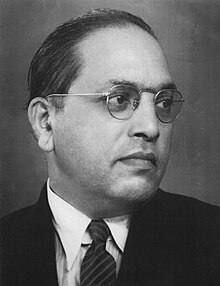
Bhimrao Ramji Ambedkar (14 April 1891 – 6 December 1956), popularly known as Babasaheb Ambedkar, was an Indian jurist, economist, politician and social reformer who inspired the Dalit Buddhist movement and campaigned against social discrimination towards the untouchables (Dalits), while also supporting the rights of women and labour. He was independent India's first law and justice minister, the architect of the Constitution of India, and a founding father of the Republic of India. In India and elsewhere, he was often called Babasaheb, meaning "respected father" in Marathi.
Ambedkar was a prolific student earning doctorates in economics from both Columbia University and the London School of Economics and gained a reputation as a scholar for his research in law, economics, and political science. In his early career, he was an economist, professor, and lawyer. His later life was marked by his political activities; he became involved in campaigning and negotiations for India's independence, publishing journals, advocating political rights and social freedom for Dalits, and contributing significantly to the establishment of the state of India. In 1956, he converted to Buddhism initiating mass conversions of Dalits. He died six months shortly after conversion.
In 1990, the Bharat Ratna, India's highest civilian award, was posthumously conferred upon Ambedkar. Ambedkar's legacy includes numerous memorials and depictions in popular culture.
|
Bhimrao Ramji Ambedkar
| |
|---|---|
Ambedkar as a young man
| |
| Member of parliament of Rajya Sabha for Bombay State | |
| In office 3 April 1952 – 6 December 1956 | |
| President | Rajendra Prasad |
| Prime Minister | Jawaharlal Nehru |
| 1st Minister of Law and Justice | |
| In office 15 August 1947 – September 1951 | |
| President | Rajendra Prasad |
| Governor General | Louis Mountbatten C. Rajagopalachari |
| Prime Minister | Jawaharlal Nehru |
| Preceded by | Position established |
| Succeeded by | Charu Chandra Biswas |
| Chairman of the Constitution Drafting Committee | |
| In office 29 August 1947 – 24 January 1950 | |
| Labour Member, Viceroy's Executive Council | |
| In office 1942–1946 | |
| Governor General | The Marquess of Linlithgow The Viscount Wavell |
| Preceded by | Feroz Khan Noon |
| Leader of the Opposition in the Bombay Legislative Assembly | |
| In office 1937–1942 | |
| Member of the Bombay Legislative Assembly | |
| In office 1937–1942 | |
| Constituency | Bombay City (Byculla & Parel) General Urban |
| Member of the Bombay Legislative Council | |
| In office 1926–1936 | |
| Personal details | |
| Pronunciation | Bhīmrāo Rāmjī Āmbēḍkar |
| Born |
Bhimrao Ramji Sakpal
14 April 1891 Mhow, Central Provinces, British India (present-day Dr. Ambedkar Nagar, Indore district, Madhya Pradesh, India) |
| Died | 6 December 1956 (aged 65) Delhi, New Delhi, India |
| Resting place | Chaitya Bhoomi, Mumbai, (present day Maharashtra), India |
| Citizenship | Indian |
| Nationality | Indian |
| Political party | • Independent Labour Party • Scheduled Castes Federation |
| Other political affiliations | Republican Party of India |
| Spouse(s) |
|
| Children | Yashwant Ambedkar |
| Parents |
|
| Relatives | See Ambedkar family |
| Residence | • Rajgruha, Dadar, Mumbai • 26 Alipur road, New Delhi |
| Education | B.A. (1913) M.A. (twice, 1915 & 1916) Ph.D. (1916, awarded in 1927) M.Sc. (1921) Barrister-at-law (1922) D.Sc. (1923) LL.D. (1952, hon.) D.Litt. (1953, hon.) |
| Alma mater | |
| Occupation | Lawyer and Professor |
| Profession | Jurist, economist, politician, social reformer, anthropologist, author, historian, sociologist, social scientist, educationist, freedom fighter, journalist, human rights activist, philosopher |
| Known for | Dalit rights movement, Constitution of India, Dalit Buddhist movement, Ambedkarism |
| Awards | Bharat Ratna (posthumously in 1990) |
Contents
- 1Early life
- 2Education
- 3Opposition to untouchability
- 4Poona Pact
- 5Political career
- 6Opposition to Aryan invasion theory
- 7Drafting India's Constitution
- 8Economic planning
- 9Second marriage
- 10Conversion to Buddhism
- 11Death
- 12Personal life
- 13Influence and legacy
- 14In popular culture
- 15Films and television series
- 16Literary works
- 17Awards and honours
- 18See also
- 19Notes
- 20References
- 21Cited sources
- 22Further reading
- 23External links
Early life
Ambedkar was born on 14 April 1891 in the town and military cantonment of Mhow (present-day Dr. Ambedkar Nagar) in the Central Provinces (present-day Madhya Pradesh).[1] He was the 14th and last child of Ramji Maloji Sakpal, an army officer who held the rank of Subedar, and Bhimabai Sakpal, daughter of Laxman Murbadkar.[2] His family was of Marathi background from the village of Ambadawe (Mandangad taluka) in Ratnagiri district of modern-day Maharashtra. Ambedkar was born into a poor low Mahar (dalit) caste, who were treated as untouchables and subjected to socio-economic discrimination.[3] Ambedkar's ancestors had long worked for the army of the British East India Company, and his father served in the British Indian Army at the Mhow cantonment.[4] Although they attended school, Ambedkar and other untouchable children were segregated and given little attention or help by teachers. They were not allowed to sit inside the class. When they needed to drink water, someone from a higher caste had to pour that water from a height as they were not allowed to touch either the water or the vessel that contained it. This task was usually performed for the young Ambedkar by the school peon, and if the peon was not available then he had to go without water; he described the situation later in his writings as "No peon, No Water".[5] He was required to sit on a gunny sack which he had to take home with him.[6]
Ramji Sakpal retired in 1894 and the family moved to Satara two years later. Shortly after their move, Ambedkar's mother died. The children were cared for by their paternal aunt and lived in difficult circumstances. Three sons – Balaram, Anandrao and Bhimrao – and two daughters – Manjula and Tulasa – of the Ambedkars survived them. Of his brothers and sisters, only Ambedkar passed his examinations and went to high school. His original surname was Sakpal but his father registered his name as Ambadawekar in school, meaning he comes from his native village of Ambadawe in Ratnagiri district.[7][8] His Devrukhe Brahmin teacher, Krishna Keshav Ambedkar, changed his surname from "Ambadawekar" to his own surname "Ambedkar" in school records.[9][10][11][12]
Education
Post-secondary education
In 1897, Ambedkar's family moved to Mumbai where Ambedkar became the only untouchable enrolled at Elphinstone High School. In 1906, when he was about 15 years old, his marriage to a nine-year-old girl, Ramabai, was arranged.[13]
Undergraduate studies at the University of Bombay

In 1907, he passed his matriculation examination and in the following year he entered Elphinstone College, which was affiliated to the University of Bombay, becoming, according to him, the first from his Mahar caste to do so. When he passed his English fourth standard examinations, the people of his community wanted to celebrate because they considered that he had reached "great heights" which he says was "hardly an occasion compared to the state of education in other communities". A public ceremony was evoked, to celebrate his success, by the community, and it was at this occasion that he was presented with a biography of the Buddha by Dada Keluskar, the author and a family friend.[13][14]
By 1912, he obtained his degree in economics and political science from Bombay University, and prepared to take up employment with the Baroda state government. His wife had just moved his young family and started work when he had to quickly return to Mumbai to see his ailing father, who died on 2 February 1913.[15]
Postgraduate studies at Columbia University
In 1913, Ambedkar moved to the United States at the age of 22. He had been awarded a Baroda State Scholarship of £11.50 (Sterling) per month for three years under a scheme established by Sayajirao Gaekwad III (Gaekwad of Baroda) that was designed to provide opportunities for postgraduate education at Columbia University in New York City. Soon after arriving there he settled in rooms at Livingston Hall with Naval Bhathena, a Parsi who was to be a lifelong friend. He passed his M.A. exam in June 1915, majoring in Economics, and other subjects of Sociology, History, Philosophy and Anthropology. He presented a thesis, Ancient Indian Commerce. Ambedkar was influenced by John Dewey and his work on democracy.[16]
In 1916 he completed his second thesis, National Dividend of India – A Historic and Analytical Study, for another M.A.,[17] and finally he received his PhD in Economics in 1927[18] for his third thesis, after he left for London. On 9 May, he presented the paper Castes in India: Their Mechanism, Genesis and Development before a seminar conducted by the anthropologist Alexander Goldenweiser.[19]
Postgraduate studies at the London School of Economics

In October 1916, he enrolled for the Bar course at Gray's Inn, and at the same time enrolled at the London School of Economics where he started working on a doctoral thesis. In June 1917, he returned to India because his scholarship from Baroda ended. His book collection was dispatched on different ship from the one he was on, and that ship was torpedoed and sunk by a German submarine.[15] He got permission to return to London to submit his thesis within four years. He returned at the first opportunity, presented his thesis titled "Provincial Decentralization of Imperial Finance in British India", and completed a master's degree (M.Sc.) in 1921.[20][21] In 1922, he was called to the Bar by Gray's Inn[22] and in 1923 he presented his thesis titled "The problem of the rupee: Its origin and its solution".[23] He completed a D.Sc. in Economics in the same year. His third and fourth Doctorates (LL.D, Columbia, 1952 and D.Litt., Osmania, 1953) were conferred honoris causa.[24]
Opposition to untouchability

As Ambedkar was educated by the Princely State of Baroda, he was bound to serve it. He was appointed Military Secretary to the Gaikwad but had to quit in a short time. He described the incident in his autobiography, Waiting for a Visa.[25] Thereafter, he tried to find ways to make a living for his growing family. He worked as a private tutor, as an accountant, and established an investment consulting business, but it failed when his clients learned that he was an untouchable.[26] In 1918, he became Professor of Political Economy in the Sydenham College of Commerce and Economics in Mumbai. Although he was successful with the students, other professors objected to his sharing a drinking-water jug with them.[27]
Ambedkar had been invited to testify before the Southborough Committee, which was preparing the Government of India Act 1919. At this hearing, Ambedkar argued for creating separate electorates and reservations for untouchables and other religious communities.[28] In 1920, he began the publication of the weekly Mooknayak (Leader of the Silent) in Mumbai with the help of Shahu of Kolhapur i.e. Shahu IV (1874–1922).[29]
Ambedkar went on to work as a legal professional. In 1926, he successfully defended three non-Brahmin leaders who had accused the Brahmin community of ruining India and were then subsequently sued for libel. Dhananjay Keer notes that "The victory was resounding, both socially and individually, for the clients and the Doctor."[30][31]
While practising law in the Bombay High Court, he tried to promote education to untouchables and uplift them. His first organised attempt was his establishment of the central institution Bahishkrit Hitakarini Sabha, intended to promote education and socio-economic improvement, as well as the welfare of "outcastes", at the time referred to as depressed classes.[32] For the defence of Dalit rights, he started five periodicals – Mooknayak (the leader of the dumb, 1920), Bahishkrit Bharat (Ostracized India, 1924), Samta (Equality, 1928), Janata (The People, 1930), and Prabuddha Bharat (Enlightened India, 1956).[33]
He was appointed to the Bombay Presidency Committee to work with the all-European Simon Commission in 1925.[34] This commission had sparked great protests across India, and while its report was ignored by most Indians, Ambedkar himself wrote a separate set of recommendations for the future Constitution of India.[35]
By 1927, Ambedkar had decided to launch active movements against untouchability. He began with public movements and marches to open up public drinking water resources. He also began a struggle for the right to enter Hindu temples. He led a satyagraha in Mahad to fight for the right of the untouchable community to draw water from the main water tank of the town.[36] In a conference in late 1927, Ambedkar publicly condemned the classic Hindu text, the Manusmriti (Laws of Manu), for ideologically justifying caste discrimination and "untouchability", and he ceremonially burned copies of the ancient text. On 25 December 1927, he led thousands of followers to burn copies of Manusmrti.[37][38] Thus annually 25 December is celebrated as Manusmriti Dahan Din (Manusmriti Burning Day) by Ambedkarites and Dalits.[39][40]
In 1930, Ambedkar launched Kalaram Temple movement after three months of preparation. About 15,000 volunteers assembled at Kalaram Temple satygraha making one of the greatest processions of Nashik. The procession was headed by a military band, a batch of scouts, women and men walked in discipline, order and determination to see the god for the first time. When they reached to gate, the gates were closed by Brahmin authorities.[41] When Babasaheb Ambedkar visited to Kathmandu, Nepal to attend the Fourth World Buddhist Conference in 1956.[42] There he went to the Dalit settlements of Kathmandu city, and saw the condition of Nepali Dalits, he was visibly angry. When this matter became known to the then Prime Minister of Nepal Tanka Prasad Acharya, then the Prime Minister himself came to Sheetal Niwas (guest house and Rastrapati Bhawan of Nepal), where Ambedkar stayed and assured Ambedkar that due attention will be given to improving the condition of the Dalits. Ambedkar had called for the Dalits of Nepal to start their struggle to get their rights. The Nepali Ambedkarite movement is run by Dalit leaders, and most of the Dalit leaders of Nepal convinced that "Ambedkar's philosophy" (Ambedkarism) is only the way to get rid of caste-based discrimination.[43]
Poona Pact

In 1932, British announced the formation of a separate electorate for "Depressed Classes" in the Communal Award. Gandhi fiercely opposed a separate electorate for untouchables, saying he feared that such an arrangement would divide the Hindu community.[44][45][46] Gandhi protested by fasting while imprisoned in the Yerwada Central Jail of Poona. Following the fast, Congress politicians and activists such as Madan Mohan Malaviya and Palwankar Baloo organised joint meetings with Ambedkar and his supporters at Yerwada.[47] On 25 September 1932, the agreement known as Poona Pact was signed between Ambedkar (on behalf of the depressed classes among Hindus) and Madan Mohan Malaviya (on behalf of the other Hindus). The agreement gave reserved seats for the depressed classes in the Provisional legislatures, within the general electorate. Due to the pact, the depressed class received 148 seats in the legislature, instead of the 71 as allocated in the Communal Award earlier proposed by British Prime Minister Ramsay MacDonald. The text uses the term "Depressed Classes" to denote Untouchables among Hindus who were later called Scheduled Castes and Scheduled Tribes under India Act 1935, and the later Indian Constitution of 1950.[48][49] In the Poona Pact, a unified electorate was in principle formed, but primary and secondary elections allowed Untouchables in practice to choose their own candidates.[50]
Political career

A photograph of the election manifesto of the All India Scheduled Caste Federation, the party founded by Ambedkar, 1946
See also: Republican Party of India
Ambedkar's political career started in 1926 and he continued to hold various positions in the political field until 1956. In December 1926, the Governor of Bombay nominated him as a member of the Bombay Legislative Council; he took his duties seriously, and often delivered speeches on economic matters. He was a member of the Bombay Legislative Council until 1936.[22][51][52][53]
In 1935, Ambedkar was appointed principal of the Government Law College, Bombay, a position he held for two years. He also served as the chairman of Governing body of Ramjas College, University of Delhi, after the death of its founder, Rai Kedarnath.[54] Settling in Bombay (today called Mumbai), Ambedkar oversaw the construction of a house Rajgruha, and stocked his personal library with more than 50,000 books.[55] His wife Ramabai died after a long illness the same year. It had been her long-standing wish to go on a pilgrimage to Pandharpur, but Ambedkar had refused to let her go, telling her that he would create a new Pandharpur for her instead of Hinduism's Pandharpur which treated them as untouchables. At the Yeola Conversion Conference on 13 October in Nasik, Ambedkar announced his intention to convert to a different religion and exhorted his followers to leave Hinduism.[55] He would repeat his message at many public meetings across India.
Ambedkar published his book Annihilation of Caste on 15 May 1936.[56] It strongly criticised Hindu orthodox religious leaders and the caste system in general,[57] and included "a rebuke of Gandhi" on the subject.[58] Later, in a 1955 BBC interview, he accused Gandhi of writing in opposition of the caste system in English language papers while writing in support of it in Gujarati language papers.[59]
In 1936, Ambedkar founded the Independent Labour Party, which contested the 1937 Bombay election to the Central Legislative Assembly for the 13 reserved and 4 general seats, and secured 11 and 3 seats respectively. Ambedkar was elected to the Bombay Legislative Assembly as a legislator (MLA). He was a member of the Assembly until 1942 and during this time he also served as the Leader of the Opposition in the Bombay Legislative Assembly.[60][61]
All India Scheduled Castes Federation was a socio-political organisation founded by Ambedkar in 1942 to campaign for the rights of the Dalit community.[62][63] During the year 1942 to 1946, Ambedkar served on the Defence Advisory Committee[64] and the Viceroy's Executive Council as minister for labour.[64]
After the Lahore resolution (1940) of the Muslim League demanding Pakistan, Ambedkar wrote a 400-page tract titled Thoughts on Pakistan, which analysed the concept of "Pakistan" in all its aspects. Ambedkar argued that the Hindus should concede Pakistan to the Muslims. He proposed that the provincial boundaries of Punjab and Bengal should be redrawn to separate the Muslim and non-Muslim majority parts. He thought the Muslims could have no objection to redrawing provincial boundaries. If they did, they did not quite "understand the nature of their own demand". Scholar Venkat Dhulipala states that Thoughts on Pakistan "rocked Indian politics for a decade". It determined the course of dialogue between the Muslim League and the Indian National Congress, paving the way for the Partition of India.[65][66]
In his work Who Were the Shudras?, Ambedkar tried to explain the formation of untouchables. He saw Shudras and Ati Shudras who form the lowest caste in the ritual hierarchy of the caste system, as separate from Untouchables. Ambedkar oversaw the transformation of his political party into the Scheduled Castes Federation, although it performed poorly in the 1946 elections for Constituent Assembly of India. Later he was elected into the constituent assembly of Bengal where Muslim League was in power.[67]
Ambedkar contested in the Bombay North first Indian General Election of 1952, but lost to his former assistant and Congress Party candidate Narayan Sadoba Kajrolkar, who polled 138,137 votes compared to Ambedkar's 123,576.[68][69][70] He tried to enter Lok Sabha again in the by-election of 1954 from Bhandara, but he placed third (the Congress Party won). By the time of the second general election in 1957, Ambedkar had died.[71][72]
Ambedkar had twice became a member of the Parliament of India representing Bombay State in the Rajya Sabha, the upper house of the Indian parliament. His first term as a Rajya Sabha member was between 3 April 1952 and 2 April 1956, and his second term was to be held from 3 April 1956 to 2 April 1962, but before the expiry of the term, he died on 6 December 1956.[73]
On 30 September 1956, Ambedkar had announced the establishment of the "Republican Party of India" by dismissing the "Scheduled Castes Federation", but before the formation of the party, he passed away on 6 December 1956. After that, his followers and activists planned to form this party. A meeting of the Presidency was held at Nagpur on 1 October 1957 to establish the party. At this meeting, N. Sivaraj, Yashwant Ambedkar, P. T. Borale, A. G. Pawar, Datta Katti, D. A. Rupavate were present. The Republican Party of India was formed on 3 October 1957. N. Shivraj was elected as the President of the party.[74]
Opposition to Aryan invasion theory
Ambedkar viewed the Shudras as Aryan and adamantly rejected the Aryan invasion theory, describing it as "so absurd that it ought to have been dead long ago" in his 1946 book Who Were the Shudras?.[75]
Ambedkar viewed Shudras as originally being "part of the Kshatriya Varna in the Indo-Aryan society", but became socially degraded after they inflicted many tyrannies on Brahmins.[75]
According to Arvind Sharma, Ambedkar noticed certain flaws in the Aryan invasion theory that were later acknowledged by western scholarship. For example, scholars now acknowledge anās in Rig Veda 5.29.10 refers to speech rather than the shape of the nose. Ambedkar anticipated this modern view.[76]
Ambedkar disputed various hypotheses of the Aryan homeland being outside India, and concluded the Aryan homeland was India itself.[77] According to Ambedkar, the Rig Veda says Aryans, Dāsa and Dasyus were competing religious groups, not different peoples.[78]
Drafting India's Constitution

Ambedkar, chairman of the Drafting Committee, presenting the final draft of the Indian Constitution to Rajendra Prasad on 25 November 1949
See also: Constitution of India and Constituent Assembly of India
Upon India's independence on 15 August 1947, the new Congress-led government invited Ambedkar to serve as the nation's first Law and Justice Minister, which he accepted. On 29 August, he was appointed Chairman of the Constitution Drafting Committee, and was appointed by the Constituent Assembly to write India's new Constitution.[79]
Ambedkar was a wise constitutional expert, he had studied the constitutions of about 60 countries. Ambedkar is recognised as the "Father of the Constitution of India".[80][81] In the Constitution Assembly, a member of the drafting committee, T. T. Krishnamachari said, "(...) it happened ultimately that the burden of drafting this constitution fell on Dr. Ambedkar and I have no doubt that we are grateful to him for having achieved this task in a manner which is undoubtedly commendable."[82][83]
Granville Austin described the Indian Constitution drafted by Ambedkar as 'first and foremost a social document'. 'The majority of India's constitutional provisions are either directly arrived at furthering the aim of social revolution or attempt to foster this revolution by establishing conditions necessary for its achievement.'[84]
The text prepared by Ambedkar provided constitutional guarantees and protections for a wide range of civil liberties for individual citizens, including freedom of religion, the abolition of untouchability, and the outlawing of all forms of discrimination. Ambedkar argued for extensive economic and social rights for women, and won the Assembly's support for introducing a system of reservations of jobs in the civil services, schools and colleges for members of scheduled castes and scheduled tribes and Other Backward Class, a system akin to affirmative action.[85] India's lawmakers hoped to eradicate the socio-economic inequalities and lack of opportunities for India's depressed classes through these measures.[86] The Constitution was adopted on 26 November 1949 by the Constituent Assembly.[87]
Opposition to Article 370
Members of the Bharatiya Janata Party state that Ambedkar opposed Article 370 of the Constitution of India, which granted special status to the State of Jammu and Kashmir, and it was included in the constitution against his wishes.[88][89][90][note 1] Ambedkarite scholar Pratik Tembhurne points out that this attribution emerged for the first time in a Rashtriya Swayamsevak Sangh publication Tarun Bharat in 1991, four decades after Ambedkar's death. Its veracity is not confirmed.[91][92] According to Dhananjay Veer's biography, when asked in a press conference whether Article 370 helped solve the problem of Kashmir, he responded that it was unfair on the part of Kashmir to expect India to provide military and other necessary services but to not merge with it.[93]

Support for uniform civil code
I personally do not understand why religion should be given this vast, expansive jurisdiction, so as to cover the whole of life and to prevent the legislature from encroaching upon that field. After all, what are we having this liberty for? We are having this liberty in order to reform our social system, which is so full of inequities, discriminations and other things, which conflict with our fundamental rights.[94]
During the debates in the Constituent Assembly, Ambedkar demonstrated his will to reform Indian society by recommending the adoption of a Uniform Civil Code.[95][96] Ambedkar resigned from the cabinet in 1951, when parliament stalled his draft of the Hindu Code Bill, which sought to enshrine gender equality in the laws of inheritance and marriage.[97]
Economic planning
Ambedkar was the first Indian to pursue a doctorate in economics abroad.[98] He argued that industrialisation and agricultural growth could enhance the Indian economy.[99] He stressed investment in agriculture as the primary industry of India. According to Sharad Pawar, Ambedkar's vision helped the government to achieve its food security goal.[100] Ambedkar advocated national economic and social development, stressing education, public hygiene, community health, residential facilities as the basic amenities.[99] He calculated the loss of development caused by British rule.[101]
Ambedkar was trained as an economist, and was a professional economist until 1921, when he became a political leader. He wrote three scholarly books on economics: Administration and Finance of the East India Company, The Evolution of Provincial Finance in British India, and The Problem of the Rupee: Its Origin and Its Solution[102]
Second marriage

Ambedkar with wife Savita in 1948
Ambedkar's first wife, Ramabai, died in 1935 after a long illness. After completing the draft of India's constitution in the late 1940s, he suffered from lack of sleep, had neuropathic pain in his legs, and was taking insulin and homoeopathic medicines. He went to Bombay for treatment, and there met Dr. Sharada Kabir, a Saraswat Brahmin, whom he married on 15 April 1948, at his home in New Delhi. She was 39 years old and he was 57. Doctors recommended a companion who was a good cook and had medical knowledge to care for him.[103] She adopted the name Savita Ambedkar and cared for him the rest of his life.[104] Savita Ambedkar, who was called 'Mai' or 'Maisaheb', died on 29 May 2003, aged 94 at J J Hospital, Mumbai.[105]
Conversion to Buddhism

Ambedkar receiving the Five Precepts from Mahasthavir Chandramani on 14 October 1956. In the photograph (from right to left): Savita Ambedkar, B. R. Ambedkar, Wali Sinha and bhikkhu Chandramani.
"... I regard the Buddha's Dhamma (Buddhism) to be the best. No religion can be compared to it. If a modern man who knows science must have a religion, the only religion he can have is the Religion of the Buddha. This conviction has grown in me after thirty-five years of close study of all religions."
— Babasaheb Ambedkar, preface of The Buddha and His Dhamma, 6 April 1956[106]
On October 13, 1935 Ambedkar presided over the Yeola Conversion Conference, held in Yeola, in Nasikh District. He advised the Depressed Classes to abandon all agitation for temple-entry privileges; instead, they should leave Hinduism entirely and embrace another religion. He vowed, "I solemnly assure you that I will not die as a Hindu."[107][108] Ambedkar considered converting to Sikhism, which encouraged opposition to oppression and so appealed to leaders of scheduled castes. But after meeting with Sikh leaders, he concluded that he might get "second-rate" Sikh status, as described by scholar Stephen P. Cohen.[109]
Instead, he studied Buddhism all his life. Around 1950, he devoted his attention to Buddhism and travelled to Ceylon (now Sri Lanka) to attend a meeting of the World Fellowship of Buddhists.[110] While dedicating a new Buddhist vihara near Pune, Ambedkar announced he was writing a book on Buddhism, and that when it was finished, he would formally convert to Buddhism.[111] He twice visited Burma in 1954; the second time to attend the third conference of the World Fellowship of Buddhists in Rangoon.[42] In 1955, he founded the Bharatiya Bauddha Mahasabha, or the Buddhist Society of India.[112] He completed his final work, The Buddha and His Dhamma, in 1956 which was published posthumously.[112]
After meetings with the Sri Lankan Buddhist monk Hammalawa Saddhatissa,[113] Ambedkar organised a formal public ceremony for himself and his supporters in Deekshabhoomi, Nagpur on 14 October 1956. Accepting the Three Refuges and Five Precepts from a Buddhist monk Mahasthavir Chandramani in the traditional manner, Ambedkar completed his own conversion, along with his wife. He then proceeded to convert some 500,000 of his supporters who were gathered around him.[114] He prescribed the 22 Vows for these converts, after the Three Jewels and Five Precepts.[115] On this occasion, many upper caste Hindus too accepted Buddhism.[116] After Nagpur, on 16 October 1956, Ambedkar again gave Buddhism to more than 300,000 of his followers at Chandrapur, since the place is also known as Deekshabhoomi.[117] He then travelled to Kathmandu, Nepal to attend the Fourth World Buddhist Conference.[42] His work on The Buddha or Karl Marx and "Revolution and counter-revolution in ancient India" remained incomplete.[118]
Death
See also: Chaitya Bhoomi

Since 1948, Ambedkar suffered from diabetes. He was bed-ridden from June to October in 1954 due to medication side-effects and poor eyesight.[111] He had been increasingly embittered by political issues, which took a toll on his health. His health worsened during 1955. Three days after completing his final manuscript The Buddha and His Dhamma, Ambedkar died in his sleep on 6 December 1956 at his home in Delhi.
A Buddhist cremation was organised at Dadar Chowpatty beach (Chaitya Bhoomi) on 7 December,[119] attended by half a million grieving people.[120] A conversion program was organised on 16 December 1956, so that cremation attendees were also converted to Buddhism at the same place.[121]
Ambedkar was survived by his second wife, who died in 2003,[122] and his son Yashwant Ambedkar (known as Bhaiyasaheb).[123] Ambedkar's grandson, Prakash Ambedkar, is the former chief-adviser of the Buddhist Society of India,[124] leads the Vanchit Bahujan Aghadi[125] and has served in both houses of the Indian Parliament.[125]
A number of unfinished typescripts and handwritten drafts were found among Ambedkar's notes and papers and gradually made available. Among these were Waiting for a Visa, which probably dates from 1935–36 and is an autobiographical work, and the Untouchables, or the Children of India's Ghetto, which refers to the census of 1951.[111]
On the anniversary of his birth and death, and on Dhamma Chakra Pravartan Din (14 October) at Nagpur, at least half a million people gather to pay homage to him at his memorial in Mumbai.[126] Thousands of bookshops are set up, and books are sold. His message to his followers was "educate, agitate, and organize".[127]
Personal life
_Yashwant,_BR_Ambedkar,_Ramabai,_Laxmibai,_Mukundrao,_and_Tobby.jpg)
Ambedkar with his family members at Rajgruha in February 1934. From left – Yashwant (son), Ambedkar, Ramabai (wife), Laxmibai (wife of his elder brother, Anand), Mukund (nephew) and Ambedkar's favourite dog, Tobby
See also: Ambedkar family
Ambedkar taught Ramabai to write and read. His affectionate name for her was "Rāmu", while she called him "Saheb". They had five children – Yashwant, Gangadhar, Ramesh, Indu (daughter) and Rajratna. Apart from Yashwant (1912–1977), the other four died in their childhood. Yashwant alone survived as his descendant. His second wife Savita had no children.[128][129]
Ambedkar considered three people as his gurus or masters, and each of their contributions to his personal views and corresponding activism were immense. His first Guru was Gautama Buddha, the second was Saint Kabir, and the third was Mahatma Jyotirao Phule.[130]
Influence and legacy
Ambedkar's legacy as a socio-political reformer, had a deep effect on modern India.[131][132] In post-Independence India, his socio-political thought is respected across the political spectrum. His initiatives have influenced various spheres of life and transformed the way India today looks at socio-economic policies, education and affirmative action through socio-economic and legal incentives. His reputation as a scholar led to his appointment as free India's first law minister, and chairman of the committee for drafting the constitution. He passionately believed in individual freedom and criticised caste society. His accusations of Hinduism as being the foundation of the caste system made him controversial and unpopular among conventional Hindus.[133] His conversion to Buddhism sparked a revival in interest in Buddhist philosophy in India and abroad.[134]
Ambedkar's political philosophy has given rise to a large number of political parties, publications and workers' unions that remain active across India, especially in Maharashtra. His promotion of Buddhism has rejuvenated interest in Buddhist philosophy among sections of population in India. Mass conversion ceremonies have been organised in modern times, emulating Ambedkar's Nagpur ceremony of 1956.[135] Followers of the Navayana regard him as a bodhisattva, the Maitreya, although he never claimed it himself.[136][137][138] Outside India, during the late 1990s, some Hungarian Romani people drew parallels between their own situation and that of the downtrodden people in India and converted to Buddhism.[139] Japan's Burakumin community leaders are spreading the Ambedkar's philosophy to the Burakumin people.[140][141] The Dalits of Nepal are also influenced by Ambedkar. They see Ambedkar as their liberator and also run the Nepali Ambedkarite movement. They believes that there is the only way to eliminate caste-based discrimination and untouchability is to follow Ambedkar's philosophy: "Educate, Agitate, Organize".[142]
For his actions towards the salvation and equality of mankind, his followers and the Indian people started respectfully addressing him as "Dr. Babasaheb Ambedkar", since sometime between September–October 1927.[143] "Babasaheb" is a Marathi phrase which roughly translates, literally as "Father-Sir" (baba: father; and saheb: Sir) or "Respected Father" because millions of Indians consider him a "great liberator".[144] Ambedkar is also known as "Bhim". This name is used for many things like Bhim Janmabhoomi (birthplace of Bhim), Bhim Jayanti (birthday of Bhim), Jai Bhim (victory to Bhim), Bhim Stambh (Bhim pillar), Bhim Geet (Bhim song), Bhim flag, Bhim Army, Bhim Nagar, BHIM, Bhim Sainik (Bhim soldier), Bhim Garjana etc.[145] Jai Bhim is a greeting used by Ambedkarites, followers of Ambedkarism.[146]
Statues and monument commemorating Ambedkar are widespread throughout India,[147] as well as existing elsewhere.[148][149] Many public institutions are named in his honour, such as the Dr. Babasaheb Ambedkar International Airport, Dr. B. R. Ambedkar National Institute of Technology, Jalandhar, and Ambedkar University Delhi. A large official portrait of Ambedkar is on display in the Indian Parliament building.
Ambedkar was voted "the Greatest Indian" in 2012 by a poll organised by History TV18 and CNN IBN. Nearly 20 million votes were cast.[150] The first Prime Minister of India, Jawaharlal Nehru said that, "Dr. Babasaheb Ambedkar was a symbol of revolt against all oppressive features of the Hindu society."[151] In 2004, Columbia University honors Ambedkar in the course of its 250th birthday celebration. The University also referred him as "the founding father of modern India".[152][153][154]
The Maharashtra government acquired the house in London where Ambedkar lived during his days as a student in the 1920s. In 2015, the house was converted into a museum-cum-memorial named Dr. Bhimrao Ramji Ambedkar Memorial.[155]
The Government of India is preserving or developing five sites associated with Ambedkar as 'Panchtirtha'. Ambedkar's Panchtirtha are: Bhim Janmabhoomi (place of birth), Deekshabhoomi (land of Buddhism accepted), Statue of Equality (Mumbai), Dr. Bhimrao Ramji Ambedkar Memorial (London), and Dr. Ambedkar National Memorial.[156][157][158]
A proposal to build a grand memorial called Statue of Equality or "Dr. Babasaheb Ambedkar Memorial" was approved in 2015 to be located in Mumbai.[159] Since that time, other tall statues of Ambedkar have been announced for places such as Amravati (Dr. B. R. Ambedkar Memorial Park, 125 ft) and Hyderabad.[160]
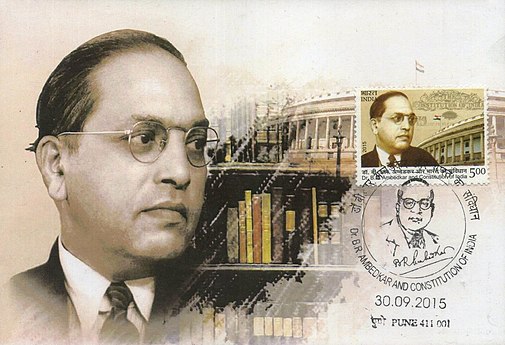 Ambedkar and the Constitution of India on a 2015 postal cover of India
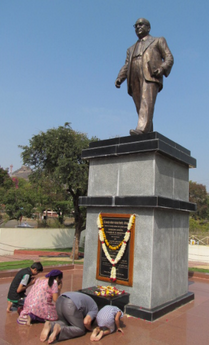 People paying tribute at the statue of Ambedkar at the Dr. Babasaheb Ambedkar Marathwada University.
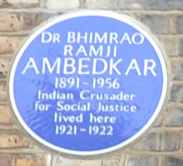 Blue Plaque dedicated to Ambedkar on Ambedkar memorial in London


In popular culture
Several movies, plays, books, songs, television serials, and other works have been based on the life and thoughts of Ambedkar. Jabbar Patel directed the English-language film Dr. Babasaheb Ambedkar in 2000 with Mammootty in the lead role.[161] This biopic was sponsored by the National Film Development Corporation of India and the government's Ministry of Social Justice and Empowerment. The film was released after a long and controversial gestation.[162] David Blundell, professor of anthropology at UCLA and historical ethnographer, has established Arising Light – a series of films and events that are intended to stimulate interest and knowledge about the social conditions in India and the life of Ambedkar.[163] In Samvidhaan,[164] a TV mini-series on the making of the Constitution of India directed by Shyam Benegal, the role of Ambedkar was played by Sachin Khedekar. The play Ambedkar Aur Gandhi, directed by Arvind Gaur and written by Rajesh Kumar, tracks the two prominent personalities of its title.[165]
Bhimayana: Experiences of Untouchability is a graphic biography of Ambedkar created by Pardhan-Gond artists Durgabai Vyam and Subhash Vyam, and writers Srividya Natarajan and S. Anand. The book depicts the experiences of untouchability faced by Ambedkar from childhood to adulthood. CNN named it one of the top 5 political comic books.[166]
Sarvavyapi Ambedkar was a Marathi series launched by ABP Majha TV channel in 2016, on the occasion of 125th birth anniversary of Ambedkar. This series had 13 episodes, with Ambedkar's 11 multi-dimensional personality expansions — Satyagrahi (Mahad Satyagraha and Kalaram Temple satyagraha), Editor, Labor Leader, Political Leader (Poona Pact and Hindu code bills), Barrister, Bibliophile, Author, Educationist, Economist, Constitution Maker and Lord Buddha's follower.[167]
The Ambedkar Memorial at Lucknow is dedicated in his memory. The chaitya consists of monuments showing his biography.[168]

The bronze statue of Ambedkar in Ambedkar Memorial at Lucknow; the base is inscribed "My struggle of life is my only message." The Ambedkar statue to modeled on the sculpture of Abraham Lincoln at the Lincoln Memorial in Washington, D.C..
Ambedkar's birthdate is an annual festival and a public holiday celebrated as Ambedkar Jayanti or Bhim Jayanti.[169] Ambedkar Jayanti is celebrated not just in India but all around the world.[170] The United Nations has celebrated Ambedkar Jayanti since 2016.[171][172] Indian Post issued stamps dedicated to his birthday in 1966, 1973, 1991, 2001, and 2013, and featured him on other stamps in 2009, 2015, 2016 and 2017.[173][174]
In honor of Ambedkar, Indian Constitution Day (National Law Day) is celebrated on 26 November. The day was chosen to spread the importance of the constitution and to spread thoughts and ideas of Ambedkar.[175]
Google commemorated Ambedkar's 124th birthday through a homepage doodle on 14 April 2015.[176] Government of India had Issued ₹1 coin in 1990 to mark the 100th birth anniversary in the honor of Ambedkar.[177] ₹10 and ₹125 coins commemorating Ambedkar's 125th Birth Anniversary were released for circulation in 2015.[178]
Films and television series
- Dr. Babasaheb Ambedkar, a 2000 English film directed by Jabbar Patel, the role of Ambedkar was played by Mammootty.
- Dr. B. R. Ambedkar, a 2005 Kannada film directed by Sharan Kumar Kabbur, the role of Ambedkar was played by Vishnukanth B. J..
- Ramabai Bhimrao Ambedkar, a 2011 Marathi film directed by Prakash Jadhav, the role of B. R. Ambedkar was played by Ganesh Jethe.
- Ramabai, a 2016 Kannada film directed by M. Ranganath, the role of B. R. Ambedkar was played by Siddaram Karnik.
- Ramai, an upcoming Marathi film directed by Bal Bargale.[179]
- Pradhanmantri, a 2013–14 television series aired on ABP News starring Surendra Pal as B. R. Ambedkar.[180]
- Samvidhaan (2014), a television series aired on Rajya Sabha TV starring Sachin Khedekar as B. R. Ambedkar.
- Periyar, a 2007 Tamil biographical film directed by Gnana Rajasekaran, the role of B. R. Ambedkar was played by Mohan Ram.
- Dr. Babasaheb Ambedkar : Mahamanvachi Gauravgatha (2019), a Marathi television series airing on Star Pravah starring Sagar Deshmukh as Ambedkar.[181]
- Ek Mahanayak : Dr. B. R. Ambedkar (2019), an upcoming Hindi television series will broadcast on &TV starring Aarav Shriwastav as Dr. B. R. Ambedkar.[182]
Literary works

Cover of the first edition of Annihilation of Caste, 1936

Babasaheb Ambedkar was a prolific and eminent writer. He had written the most among his contemporary politicians.[183] He had written a total of 32 books (10 are incomplete), 10 memoranda, evidence and statement, 10 research documents, review of articles and books and 10 preface and predictions.[184] Apart from this he is also the author of the Indian Constitution. The Buddha and His Dhamma is the last book of Ambedkar, the text is the scripture for those who follow Navayana Buddhism.[185] Waiting for a Visa is his autobiography, The book is used as a textbook in Columbia University.[186][187] He also wrote Pali dictionary (Pali to English). Ambedkar was known to have knowledge of eleven languages, including Marathi (mother tongue), English, Hindi, Pali, Sanskrit, Gujarati, German, Persian, French, Kannada and Bengali.[188] But he used the Marathi language of his journals (fortnightly, weekly) because Marathi is a native of Maharashtra, except for his almost all writings in the English language.
Books and Monographs
- completed books[189]
- Administration and finance of the East India Company
- The Evolution of Provincial Finance in British India, 1925
- The problem of the Rupees: Its Origin and Its Solution, 1923
- Annihilation of Caste, 1936
- Which way to Emancipation?, 1936
- Federation versus Freedom, 1936
- Pakistan or the Partition of India [Thoughts on Pakistan], 1940
- Rande, Gandhi and Jinnah, 1943
- Mr. Gandhi and the Emancipation of the Untouchables, 1943
- What Congress and Gandhi Have Done to the Untouchables, 1945
- Communal Deadlock and a Way to Solve It, 1946
- Who Were the Shudras?, 1946
- A critique of The Proposals of Cabinet Mission for Indian Constitution changes in so far as they affect the Scheduled Castes (Untouchable), 1946
- The Cabinet Mission and the Untouchables, 1946
- States and Minorities, 1947
- Maharashtra as a Linguist Province, 1948
- The Untouchables: Who Were They are Why The Become Untouchables, 1948
- Thoughts on Linguistic States: A critique of the Report of the States Reorganization Commission, 1955
- The Buddha and His Dhamma, 1957
- Riddle's in Hinduism
- Dictionary of Pali Language [Pali-English]
- The Pali Grammar
- incomplete books[190]
- Waiting for a Visa (autobiography)
- A people at Bay
- Untouchables or the Children of India's Ghetto
- Can I be a Hindu?
- What the Brahmins Have Done to the Hindus
- Essays of Bhagwat Gita
- India and Communism
- Revolution and Counter-revolution in Ancient India
- Buddha and Karl Marx
- Constitution and Constitutionalism
Dr. Babasaheb Ambedkar: Writings and Speeches
The Education Department, the Government of Maharashtra has plans to publish the entire writings of Ambedkar, under the guidance of a committee established for the purpose in 1976. As of 2018, 22 volumes. titled Dr. Babasaheb Ambedkar: Writings and Speeches (BAWS), have been published in the English language, comprising over 15,000 pages. Since 1987, work has been in progress to translate BAWS into Marathi and there are also official Hindi translations available for a part of the set.[191]
- Castes in India: Their Mechanism, Genesis and Development and 11 Other Essays
- Ambedkar in the Bombay Legislature, with the Simon Commission and at the Round Table Conferences, 1927–1939
- Philosophy of Hinduism; India and the Pre-requisites of Communism; Revolution and Counter-revolution; Buddha or Karl Marx
- Riddles in Hinduism
- Essays on Untouchables and Untouchability
- The Evolution of Provincial Finance in British India
- The Untouchables: Who Were They? And Why They Became Untouchables (New Delhi: Amrit Book Co, [1948])
- Annihilation of Caste (1936)
- Pakistan or the Partition of India
- What Congress and Gandhi have done to the Untouchables; Mr. Gandhi and the Emancipation of the Untouchables
- Ambedkar as member of the Governor General's Executive Council, 1942–46
- The Buddha and his Dhamma
- Unpublished Writings; Ancient Indian Commerce; Notes on laws; Waiting for a Visa; Miscellaneous notes, etc.
- Ambedkar as the principal architect of the Constitution of India
- (2 parts) Dr. Ambedkar and The Hindu Code Bill
- Ambedkar as Free India's First Law Minister and Member of Opposition in Indian Parliament (1947–1956)
- The Pali Grammar
- Ambedkar and his Egalitarian Revolution – Struggle for Human Rights. Events starting from March 1927 to 17 November 1956 in the chronological order; Ambedkar and his Egalitarian Revolution – Socio-political and religious activities. Events starting from November 1929 to 8 May 1956 in the chronological order; Ambedkar and his Egalitarian Revolution – Speeches. (Events starting from 1 January to 20 November 1956 in the chronological order.)
- Ambedkar's Speeches and writing in Marathi
- Ambedkar's Photo Album and Correspondence
Awards and honours
_on_June_5,_1952.jpg)
Ambedkar with Wallace Stevens at Columbia University after receiving Doctor of Laws on 5 June 1952
Aside from his honorary degrees, Ambedkar was posthumously awarded India's highest civilian award, the Bharat Ratna, in 1990.[192]
Jump to navigation| Signature |  |
|---|---|











 Posts
Posts


